As Galileo studied at Padua, he began building a telescope and finished in 1604. Upon completion, he began building more and more support for the Copernican theory supporting that the Earth was not the center of the universe. Because this view challenged the Aristotle view, which was taught by the Catholic Church, Galileo began getting a lot of grief. In an attempt to avoid issues, Galileo wrote a letter explaining how the Copernican theory did not contradict the Bible. His biggest point was that the scripture was written from the perspective of people living on Earth with no access to these new scientific principles that provide an alternate (accurate) perspective.
 |
| Pope Urban VIII |
Thanks to this permission, Galileo published Dialogue Concerning the Two Chief World Systems in 1632. But this work advocated for Copernican theory, and thus got him in trouble. The Church did not react too kindly to this work and summoned Galileo to Rome. From September of 1632 to July 1633 Galileo was tried and questioned, but also treated with respect about his ideals. Towards the end, he was threatened and tortured until he admitted that he had supported Copernican theory through the published work. Because of this, he was convicted of heresy and placed on house arrest for the remainder of his life.
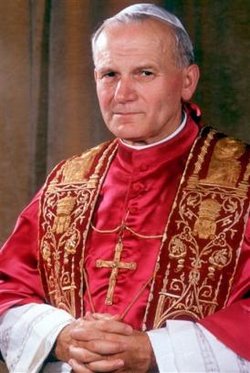 |
| Pope John Paul II |
Eventually the Church could no longer ignore Galileo's works, and in 1758 (over a century after his death) it lifted the ban on the majority of Galileo's works that supported Copernican theory. In the 20th century, several popes acknowledged the great work of Galileo. But it took until 1992 for Pope John Paul II to express regret about how the Church treated the Galileo situation with Copernican theory.

No comments:
Post a Comment